
Poor accessibility costs a business more than you might think: wasted time, missed appointments, and employees who grow frustrated and disengage. An office location that is difficult to reach or has barely any parking directly slows your growth. In this article, we answer the most frequently asked questions about accessibility and parking at office spaces, so you don’t overlook anything when making your next decision.
How much revenue does poor accessibility cost a business?
Poor accessibility costs a business revenue on multiple fronts simultaneously: clients who drop out before an appointment, employees who arrive late or prefer to work elsewhere, and a professional image that suffers the moment your address is hard to find or poorly connected. The exact impact varies by business, but the patterns are recognizable.
Consider a client who sits in traffic for 45 minutes or can’t find a parking spot before their first meeting with you. The likelihood of that client scheduling a second appointment is considerably lower. The same applies to employees: commute time and convenience are significant factors in choosing an employer in 2026.
Accessibility is also a signal. An office that is easy to find, conveniently located near major roads, and equipped with ample parking conveys professionalism before anyone even walks through the door. A location that falls short creates quiet reputational damage that is difficult to measure but very much felt.
What makes an office location truly accessible?
An office location is truly accessible when it can be reached quickly both by car and by public transport, without visitors or employees having to figure out how to get there. That means proximity to highways, multiple public transport options, and an address that navigation systems and Google Maps recognize immediately.
Good accessibility is made up of a combination of factors:
- Highway access: a location close to multiple highways gives you flexibility, even when one route is congested
- Public transport: multiple bus and metro lines nearby, ideally within a short walking distance
- Visibility and signage: a clear address, good wayfinding, and visibility from the road
- Parking facilities: sufficient spaces for both employees and visitors, preferably free or at a reasonable cost
- Nearby amenities: having lunch spots, a gas station, pharmacy, or supermarket close by makes a location practically more attractive
A location that scores well on all these points is not only pleasant for daily use but also a strong selling point for clients and prospective employees. When comparing office spaces, take a look at the available workspaces in Amstelveen if you’re looking for a location that excels on all of these fronts.
How many parking spaces does an office need?
A common rule of thumb is one parking space per 25 to 35 square meters of office space, but the actual number depends on your team size, the frequency of client visits, and the availability of public transport nearby. For a team of five with regular client visits, you’ll quickly need six to eight spaces.
What many tenants underestimate: visitor parking is at least as important as employee parking. If a client spends 15 minutes circling for a spot, the meeting starts off on the wrong foot. Always ask explicitly during a viewing about the ratio of reserved spaces to visitor spaces.
Also look at the practical details: are the parking spaces free or paid, how long are you allowed to park, and are there peak times when the lot fills up? Some business parks enforce a maximum daytime parking duration, which can cause problems for visitors with longer appointments.
What is the difference between accessibility in Amstelveen and on the Zuidas?
Amstelveen generally offers better accessibility by car and more generous parking than the Zuidas, while the Zuidas scores higher on public transport connections via Amsterdam Zuid station. For businesses that frequently receive clients by car or employ staff with long commutes, Amstelveen is often the more practical choice.
On the Zuidas, parking rates are high and spaces are scarce. That’s not a problem if your clients and team almost always arrive by train, but for a small business with varying visitor flows, it can become a daily bottleneck.
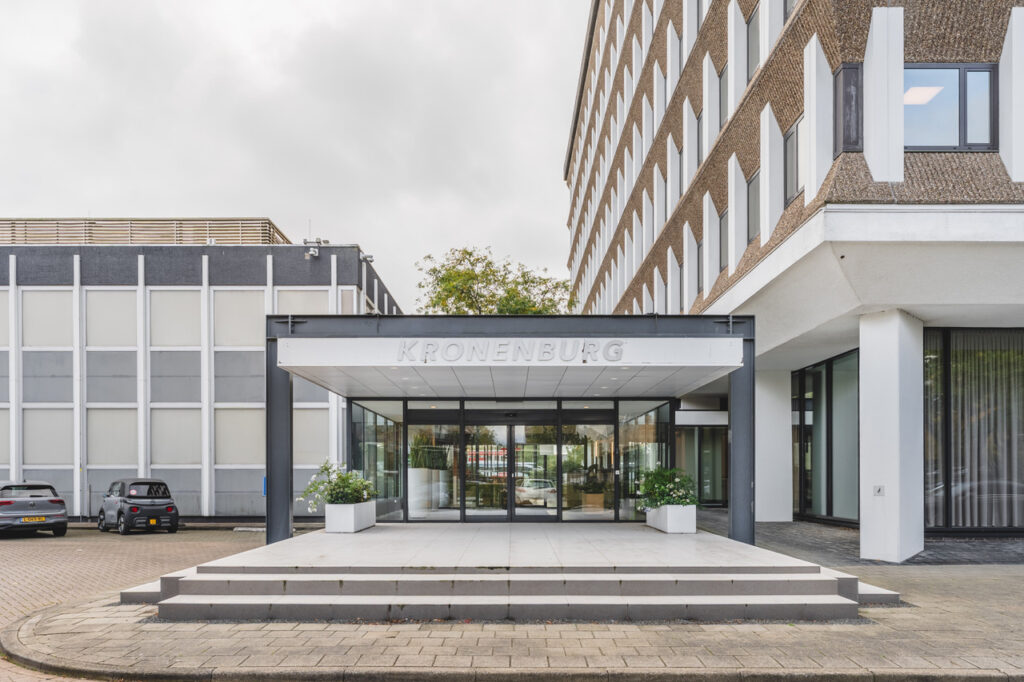
Kronenburg Offices is located in Amstelveen, directly below the Zuidas, and is accessible via the A9, A10, A2, and A4. For public transport, there are several bus lines, metro lines 50 and 51, and trams 5 and 25 nearby. Parking at the Kronenburg business park is spacious and free for tenants and visitors. That is a concrete advantage over many Zuidas locations, where the same level of accessibility comes at a significantly higher cost.
Should you factor in accessibility when comparing office prices?
Yes, accessibility should always be factored into your comparison of office prices, because a cheaper office in a poorly accessible location can quickly end up costing more once you add up commuting time, parking fees, and lost productivity. The rental price is just one component of the total cost.
Make it concrete with a simple calculation:
- How much time do employees lose on average each day commuting and finding parking?
- What are the monthly parking costs per employee?
- How many client visits do you have per month, and how does accessibility affect those appointments?
If an office is €300 per month cheaper but every employee loses an extra 30 minutes a day commuting, that advantage evaporates quickly. Browse the current availability and treat accessibility as a hard factor in your comparison.
What questions should you ask about accessibility during an office viewing?
During an office viewing, ask concrete, practical questions about accessibility so you’re not caught off guard later. The answers will give you an honest picture of how the location functions in day-to-day practice, not just on paper.
These are the questions you should always ask:
- How many parking spaces are available for tenants and visitors, and are they free?
- What public transport connections are nearby, and how far is the nearest stop?
- How is the location accessed from the highway, and what alternative routes are there during peak traffic?
- Is there 24/7 access for employees who work early or late?
- Are there peak times when parking or the entrance is blocked?
- How do visitors find the location, and is there clear signage?
Also ask whether you can visit the location on a weekday morning so you can experience firsthand how busy it gets and how long it takes to find a parking spot. That will tell you more than any brochure ever could.
How Kronenburg Offices supports accessibility and parking
Kronenburg Offices offers an office location in Amstelveen that scores strongly on every aspect of accessibility. Here is what you get in concrete terms:
- Ample, free parking for tenants and visitors at the Kronenburg business park
- Direct access to the A9, A10, A2, and A4, with Amsterdam, Schiphol, and the Zuidas all within easy reach
- Multiple public transport connections via bus lines 62, 174, 357, 463, and night bus N84, plus metro lines 50 and 51 and trams 5 and 25
- 24/7 access and security, allowing employees to work flexibly without any hassle at the entrance
- Professional reception with a staffed front desk, ensuring visitors are welcomed properly from the moment they arrive
- Turn-key office units from 25 to 85 m², all-inclusive with fiber internet, cleaning, coffee, and meeting rooms
We are happy to help you find the solution that best fits your situation, whether that’s a first workspace or a fully independent office. Read more about us and our approach, or get in touch directly to schedule a no-obligation viewing.
Related Articles
- Business center in Amstelveen: flexible rentals with professional facilities
- How do you negotiate the price when renting office space?
- How does VAT work when renting office space as an entrepreneur?
- How many square meters of office space do you need per person?
- Is renting office space deductible as business expenses in 2026?