
For most office workers, you need 6 to 10 square meters of net office space per person. For open offices, 6-8 m² per workstation is often sufficient, while private offices require 10-15 m². Your total space requirements depend on work style, meeting needs, and growth plans. Don’t forget that besides workstations, you also need space for meeting rooms, storage, and circulation.
What are the standard guidelines for office space per person?
The generally accepted standard is between 6 and 10 square meters of net office space per employee. For open office landscapes, most companies calculate 6-8 m² per workstation, including desk, chair, and immediate walking space. Private offices or enclosed workspaces require more: usually 10-15 m² per person.
These figures are based on practical experience and apply to standard office work. Legally, there is no specific minimum requirement for office space per person in the Netherlands, but the Working Conditions Act does set requirements for workstation dimensions and movement space.
Hybrid working changes the calculation. If your team isn’t in the office every day, you can calculate 4-6 m² per person by sharing flexible workstations. This is called ‘hotdesking’ and can significantly save on office space rental.
Which factors determine how much space you actually need?
Your actual space requirements depend on your business activities, work style, and growth plans. A law firm needs more meeting rooms than a software company. Creative teams often work together at large tables, while accountants mainly use individual workstations.
Important factors to include in your calculation:
- Type of work: Phone work requires more privacy than administrative work.
- Meeting frequency: Lots of client contact means more meeting rooms.
- Storage needs: Files, samples, or equipment cost extra space.
- Growth plans: Are you planning to expand within two years? Then account for that now.
- Company culture: Informal companies often have more lounge space.
Startups can often manage with less space per person because they work more flexibly. Established companies with lots of client contact usually need more representative space.
How do you calculate the total office space for your team?
Multiply the number of employees by 8 m² and add 30-40% for common areas. This rule of thumb gives you a good initial estimate for the total net office space you need.
| Space type | Percentage of total | Example for 5 people |
|---|---|---|
| Workstations | 60-70% | 40 m² (8 m² per person) |
| Meeting rooms | 15-20% | 12 m² |
| Pantry/kitchen | 5-10% | 6 m² |
| Storage/archive | 5-10% | 6 m² |
| Circulation | 10-15% | 8 m² |
| Total net | 100% | 72 m² |
This calculation applies to traditional office layouts. With modern, flexible office concepts, you can often manage with less space through smart layout and multifunctional spaces.
What is the difference between gross and net office area?
Net area is the actually usable space within your office. Gross area also includes walls, corridors, and common areas in the building. The difference can amount to 20-30%, which has a significant impact on your budget.
Net area includes:
- Workspaces and offices
- Private meeting rooms
- Private pantry or kitchen
- Private storage and archive space
Gross area additionally includes:
- Exterior walls and partition walls
- Common corridors and halls
- Shared restrooms
- Technical rooms (heating, electricity)
When comparing office space, pay close attention to whether prices are based on net or gross area. An office of 50 m² net can be 65 m² gross, which significantly affects your monthly costs.
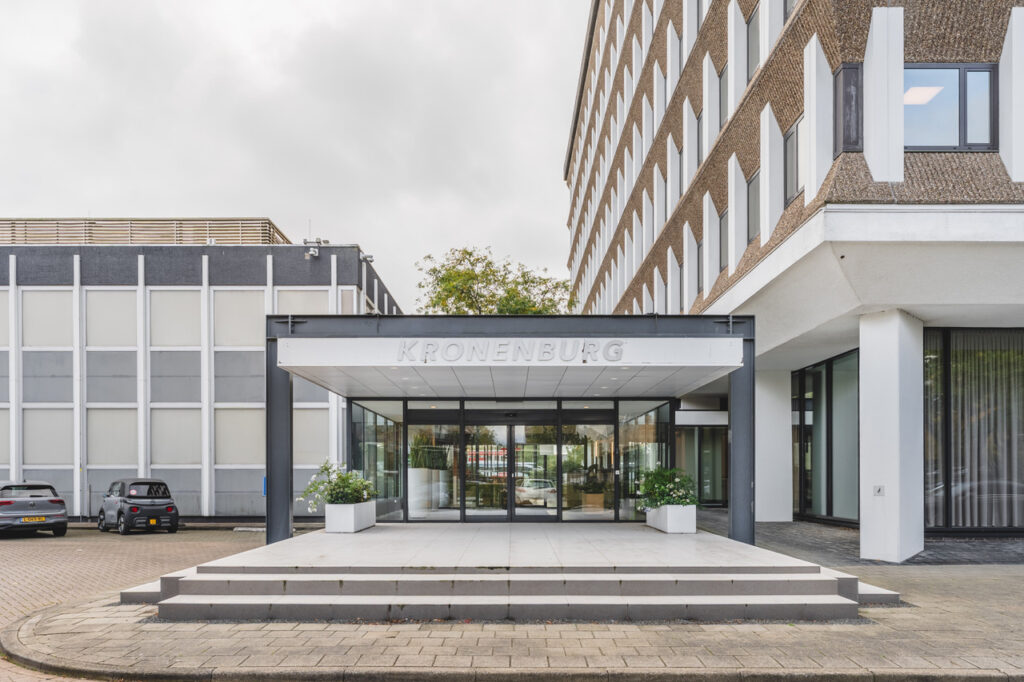
How Kronenburg Offices helps with choosing the right office space
We help entrepreneurs determine optimal office space through a personal intake and practical calculation of your actual space requirements. Our turn-key office units from 25 to 85 m² are designed for maximum efficiency without wasted space.
Here’s how we approach it:
- Space analysis: We calculate your actual needs together based on team size and work style.
- Flexible growth: Start small and expand within the same building as your team grows.
- All-inclusive advantage: Meeting rooms, pantry, and lounges are shared, so you need less private space.
- Transparent pricing: All rates are based on net area, no surprises afterward.
The advantage of our approach is that you don’t have to invest in meeting rooms or pantries yourself. That saves at least 15-20 m² of additional office space that you would otherwise have to rent. See how we’ve helped other entrepreneurs with the right office space or schedule a viewing to discuss your options.